As a well-known industry saying goes, “the brewer makes the wort, but the yeast makes the beer”.
The health of the yeast population used during pitching directly influences fundamental parameters of the brewing process, including:
-
attenuation rate;
-
ester and higher alcohol profile;
-
diacetyl reabsorption;
-
fermentation times;
-
final clarification;
-
reproducibility of the beer’s organoleptic profile.
For this reason, it is important to distinguish between two parameters that are often mistakenly considered equivalent: viability and vitality.
Viability: how many yeast cells are alive?
Viability, or cellular viability, indicates the percentage of live cells compared to the total number of cells present in the sample.
It is essentially a binary classification – live or dead cell – which in traditional methods is often determined by observing the permeability of the cell membrane to specific dyes.
Vitality: how active are the cells really?
Vitality, or cellular vitality, provides information on the physiological and metabolic state of the yeast, its energy reserves, and the ability of cells to promptly start fermentation.
Indeed, a cell may still be alive, but physiologically stressed or metabolically inactive.
This means that a biomass can exhibit a high percentage of live cells while simultaneously having low yeast vitality.
What happens when yeast has low vitality?
Using a yeast population that is numerically adequate but metabolically inactive can have significant consequences on the production process.
The main risks include:
-
longer lag phases;
-
slow or sluggish fermentations;
-
greater batch-to-batch variability;
-
higher risk of competing microbiological contaminations;
-
formation of undesirable compounds and off-flavors;
-
persistence of substances such as diacetyl or hydrogen sulfide.
Monitoring vitality thus enables the brewery to make more informed decisions before pitching and during the management of subsequent yeast generations.
Yeast repitching: why monitor vitality
Repitching, which is the harvesting and subsequent reuse of yeast from a previous fermentation, is a common practice in both industrial and craft breweries.
Reusing biomass can help reduce operational costs, but it requires accurate monitoring of the cells’ physiological condition.
With each generation, yeast can accumulate different forms of stress:
-
thermal stress;
-
osmotic stress;
-
mechanical stress;
-
toxicity related to the presence of ethanol.
After several generations, cellular energy reserves may progressively decline, compromising the yeast’s ability to effectively respond to stress and sustain a new fermentation.
Traditional methods relying solely on live cell counts may fail to detect this physiological deterioration prior to cell death.
A yeast vitality measurement allows early identification of a metabolically compromised population, helping to evaluate with greater confidence when to repitch or when to introduce fresh biomass.
Traditional methods for yeast analysis: what are the limitations?
Traditionally, many breweries use microscopy combined with staining techniques such as methylene blue for cell counting and yeast viability assessment.
However, these methodologies have limitations, especially when the goal is to obtain a more in-depth and reproducible analysis of the cells’ physiological state.
|
Method |
Measured parameter |
Advantages |
Limitations |
|
Microscopy + methylene blue |
Approximate cell count and live/dead ratio |
Low initial cost and simple instrumentation |
Operator subjectivity, limited sampling, higher inaccuracy under certain conditions, and lack of direct metabolic vitality measurement |
|
Optical flow cytometry |
Cell count and vitality parameters via fluorophores |
High precision and analysis of thousands of cells |
Requires complex instrumentation, fluorescent dyes, reagents, and calibrations |
|
Amphasys Ampha X10 – IFC |
Live/dead ratio, vitality, concentration, and cell size |
Rapid, label-free analysis, objective data, and analysis of over 10,000 cells |
Requires a dedicated instrument |
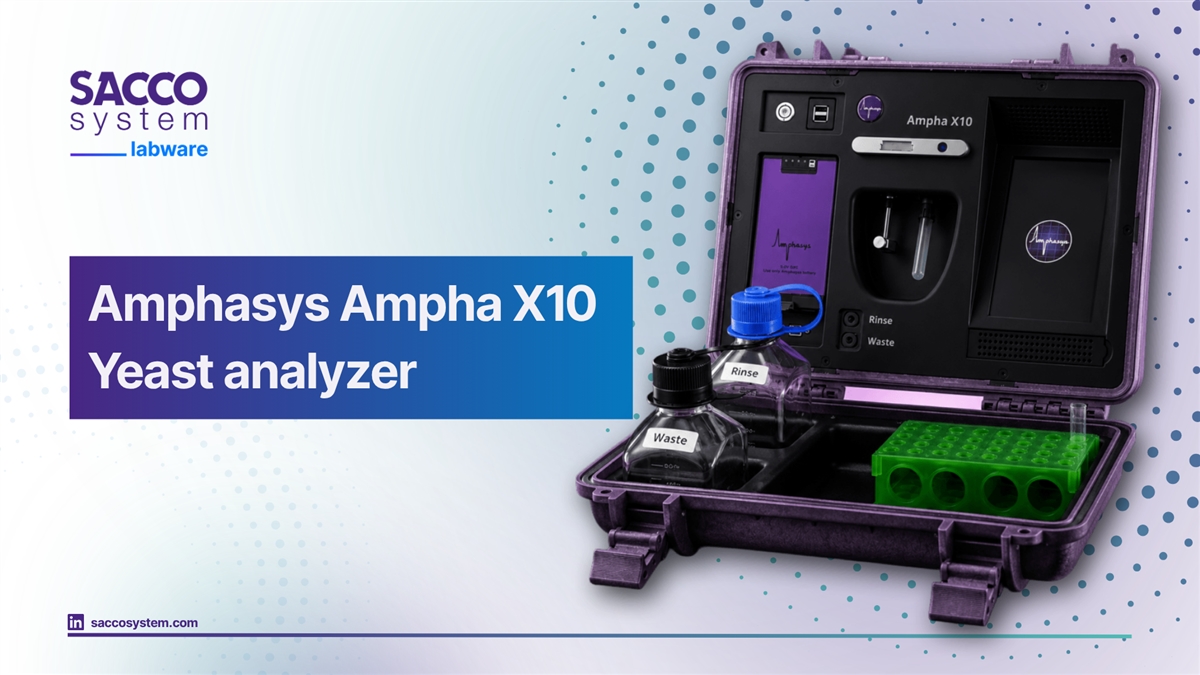
Amphasys Ampha X10: impedance flow cytometry for yeast control
Ampha X10 is an analyzer developed by Amphasys that uses impedance flow cytometry to rapidly characterize yeast cells.
Unlike other methodologies, the system allows for label-free analysis without using dyes or chemical markers.
How does impedance flow cytometry work?
During analysis, the yeast sample flows through a microfluidic microchannel equipped with microelectrodes. The instrument applies electrical fields at different frequencies and measures the electrical properties of each individual cell.
Using different frequencies provides complementary information:
-
Low frequency, around 0.5 MHz: detects information regarding cell size and concentration.
-
High frequency, around 6–12 MHz: provides information on membrane integrity and internal electrical properties of the cell, which correlate to its physiological state.
In this way, thousands of cells can be analyzed individually to build a more comprehensive overview of the yeast population state.
Benefits of Ampha X10 for breweries and quality control
1. Results in less than two minutes
The analysis takes less than two minutes from sample injection to results, enabling operators to quickly obtain actionable insights for pitching and repitching decisions.
2. Label-free analysis without reagents
Ampha X10 requires no dyes or reagents. This eliminates variables associated with incubation times, dye preparation, or reagent degradation, streamlining the analytical workflow.
3. Analysis of over 10,000 cells
For each run, the system can analyze over 10,000 single cells, providing a significantly broader statistical foundation compared to manual microscopic counting.
4. Enhanced repitching control
By monitoring the physiological state of the biomass, the brewery can detect a loss of vitality more quickly and decide whether to reuse the yeast or replace it before its condition negatively impacts fermentation.
What benefits can more accurate vitality control bring?
Integrating vitality measurement into the brewery’s quality control can improve both process efficiency and finished product consistency.
Reduced fermentation times
Pitching based on the actual amount of viable and metabolically active cells can help shorten the lag phase and promote a faster fermentation startup.
Reduced risk of off-spec fermentations
Identifying a physiologically compromised yeast population in advance reduces the risk of slow or stuck fermentations and subsequent corrective actions.
Optimized biomass utilization
Evaluating vitality allows for more informed decisions on the number of repitching cycles, avoiding premature disposal of performing biomass or the reuse of over-stressed yeast.
Greater reproducibility across batches
Tighter control over yeast condition helps maintain consistent parameters such as attenuation, flavor and ester production, and overall fermentation characteristics, contributing to batch-after-batch reproducibility.
From viability to vitality: a new approach to yeast control
For a modern brewery, simply knowing how many cells are alive may not be enough. Understanding how active and ready to ferment these cells truly are provides a more complete picture of biomass health.
By combining microfluidics, impedance flow cytometry, label-free analysis, and rapid execution, Amphasys Ampha X10 represents an advanced solution for yeast vitality control and the optimization of fermentation and repitching processes.
Want to improve yeast control in your brewery?
Sacco System Labware supports breweries, quality control laboratories, and production departments in selecting and implementing advanced analytical solutions.
Contact us to discover how Amphasys Ampha X10 can help you monitor yeast vitality, optimize pitching and repitching, and enhance fermentation reproducibility.