Bacillus cereus is a microorganism widely distributed in the environment and can be present in soil, raw materials, production environments, and numerous food categories.
One of its most relevant characteristics is its ability to produce resistant spores. These forms can survive adverse environmental conditions and some processes normally used in food production, such as:
-
heat treatments;
-
drying;
-
freezing;
-
prolonged storage;
-
exposure to different environmental conditions.
Under favorable conditions, spores can germinate and give rise to vegetative cells capable of multiplying in the food. Certain strains belonging to the Bacillus cereus sensu lato group can also produce toxins associated with foodborne illness outbreaks.
Control of this microorganism is therefore particularly important in HACCP plans and microbiological monitoring programs of food companies.
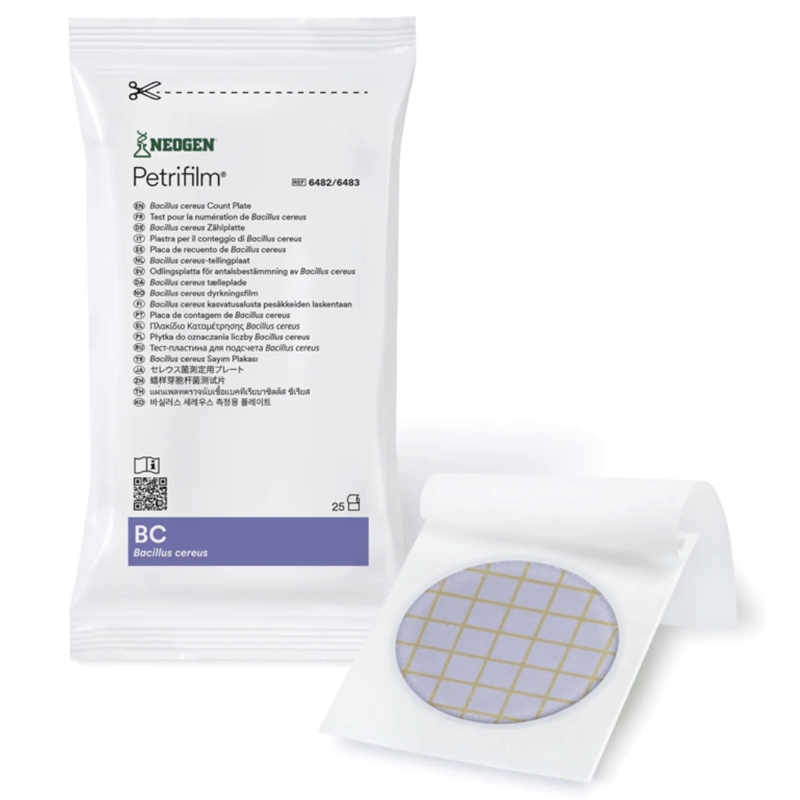
Petrifilm™ Bacillus cereus: a ready-to-use solution
Neogen Petrifilm™ plates are ready-to-use culture systems designed to simplify daily laboratory activities.
The version dedicated to Bacillus cereus allows the enumeration of microorganisms belonging to the Bacillus cereus sensu lato group using a compact plate, without having to prepare the culture medium in advance.
The sample is inoculated directly onto the plate, which already contains the nutrients and selective agents required for the development and identification of characteristic colonies.
Results in approximately 24 hours
One of the main operational advantages of Petrifilm™ Bacillus cereus is the reduction in time required to obtain results.
The method allows inoculating 1 ml of sample directly onto a single plate and proceeding with reading after approximately 20-24 hours of incubation, depending on the protocol applied.
Compared to the traditional procedure outlined by the reference method ISO 7932, the analytical workflow is simpler and requires fewer plates, materials, and manual steps. The standardization of the procedure also helps reduce the possibility of errors during sample preparation, plating, and handling.
All the practical advantages for the laboratory
The use of Petrifilm™ Bacillus cereus plates offers several benefits in microbiological control activities:
-
reduction in media preparation time;
-
results available in approximately one day;
-
direct 1 ml inoculation onto a single plate;
-
lower usage of plates and consumables;
-
reduction of space required for storage and incubation;
-
simpler and more standardized procedure;
-
lower production of laboratory waste;
-
greater efficiency in managing numerous samples.
The compact format also allows optimizing space inside incubators, a particularly relevant advantage for laboratories performing a high volume of analyses daily.
Validations and scope of application
The Petrifilm™ Bacillus cereus method is validated as an AOAC Official Method of Analysis, AOAC Performance Tested Method, and MicroVal for the enumeration of microorganisms belonging to the Bacillus cereus sensu lato group.
The plates can be used on a wide range of matrices and are suitable for the needs of quality control laboratories, food producers, and contract testing facilities.
As with any analytical method, it is necessary to follow the manufacturer's instructions and verify that the tested matrix falls within the scope of application covered by the validation.
Towards more efficient management of microbiological control
Having rapid access to Bacillus cereus counts helps companies promptly assess product compliance and the effectiveness of adopted hygiene procedures.
Neogen Petrifilm™ plates represent a practical solution to integrate the monitoring of this microorganism into self-control programs, reducing operational complexity and improving the organization of laboratory activities.
Labware by Sacco System distributes Petrifilm™ Bacillus cereus Count Plates and offers technical support in selecting and introducing Neogen solutions into microbiological analysis protocols.
Would you like more information?
Discover Petrifilm™ Bacillus cereus available on the Labware by Sacco System website in packs of 50 plates or in packs of 500 plates, or contact our team to receive technical information, availability, and support in choosing the format best suited to your laboratory's needs.