The new regulatory framework affects ready-to-eat foods that can support the growth of Listeria monocytogenes.
When the manufacturer is able to demonstrate, with evidence deemed satisfactory by the competent authority, that the concentration of Listeria monocytogenes will not exceed 100 CFU/g during the entire shelf-life, the corresponding quantitative criterion can be applied.
However, when this demonstration is not available or is not considered sufficient, as of 1 July 2026 the criterion of absence in 25 grams applies to the product throughout its entire commercial life, and not only before it leaves the immediate control of the food business operator who produced it.
The amendment therefore makes central the company's ability to collect, organize, and document the information used to establish the microbiological safety of the product.
Which foods are affected
The Regulation applies to ready-to-eat foods, i.e. intended for direct human consumption without the need for cooking or other processing effective to eliminate or reduce to an acceptable level microorganisms of concern.
Particular attention is required for foods that, due to their formulation and storage conditions, can support the growth of Listeria monocytogenes. Depending on the specific characteristics of the product, this category may include:
-
cheeses and other dairy products;
-
cured meats, cooked meats, and refrigerated preparations;
-
smoked or processed fishery products;
-
ready meals;
-
refrigerated deli products;
-
ready-to-eat plant products;
-
packaged foods with a relatively long shelf-life.
However, classification does not depend solely on the product category. The actual characteristics of the food, the production process, packaging, foreseeable distribution and storage temperatures, and the duration of the shelf-life must be considered.
How to demonstrate safety during shelf-life
Testing only the finished product is not sufficient on its own to describe the behavior of Listeria monocytogenes during the entire storage period.
Usable documentation may include:
-
physicochemical characterization of the product;
-
pH and water activity measurements;
-
historical production and control data;
-
applicable scientific literature;
-
predictive microbiology models;
-
challenge tests;
-
durability studies;
-
environmental microbiological monitoring results.
This information must be evaluated overall. Indeed, a single compliant analysis does not automatically prove that the microbiological limit will be respected in all produced units and for the entire shelf-life.
The role of water activity
Water activity, indicated as aw, expresses the availability of water in the food for chemical reactions and for the growth of microorganisms.
It should not be confused with simple moisture content: two products with similar water amounts can display different aw values and, consequently, a different capacity to support microbial development.
Together with pH, temperature, formulation, preservatives, packaging, and present microflora, water activity contributes to assessing the growth potential of Listeria monocytogenes.
The regulatory framework generally considers products unable to support the growth of the microorganism if they have:
-
pH not exceeding 4.4;
-
or aw not exceeding 0.92;
-
or pH not exceeding 5.0 combined with aw not exceeding 0.94;
-
or a shelf-life of less than five days.
These parameters must nevertheless be measured and documented correctly, considering variability between batches and identifying the most unfavorable conditions reasonably foreseeable.
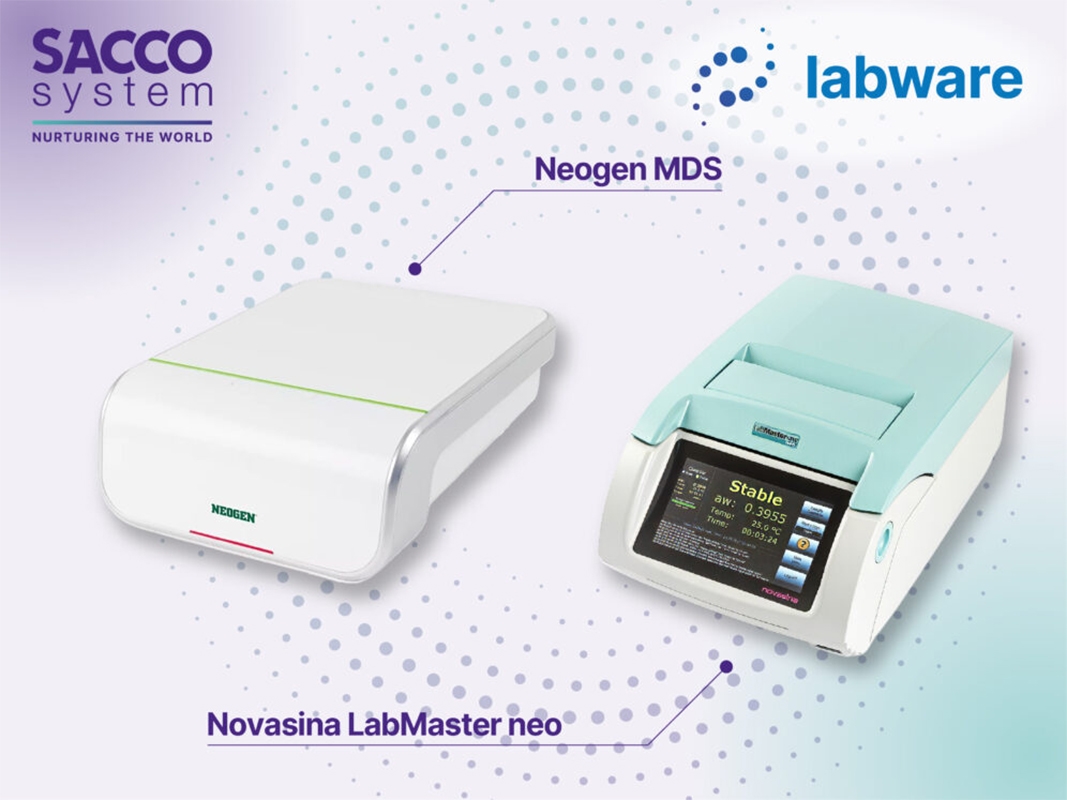
Measuring water activity with Novasina LabMaster-AW Neo
For measuring water activity, Labware offers Novasina LabMaster-AW Neo, an instrument designed to obtain accurate, reproducible, and traceable results.
The system operates in a range between 0.0300 and 1.0000 aw, with temperature control from 0 to 60 °C. It also integrates logging functions, calibration management, alarm limit setting, and operation traceability.
A reliable aw measurement can support:
-
physicochemical characterization of the food;
-
classification of RTE products;
-
definition of worst-case scenarios to study;
-
predictive microbiology models;
-
challenge test design;
-
control of production consistency between batches;
-
shelf-life documentation.
The water activity value does not replace any necessary microbiological studies, but it represents one of the fundamental elements for setting up and interpreting them correctly.
Discover Novasina LabMaster-AW Neo on the Labware website >
Rapid pathogen testing with Neogen MDS
Alongside product characterization, reliable microbiological methods are required for detecting Listeria monocytogenes in food and Listeria spp. in the production environment.
The Neogen Molecular Detection System, or MDS, uses isothermal amplification technology with bioluminescent detection. The system enables molecular pathogen testing through a standardized workflow that is faster than many traditional culture methods.
The specific MDS kit for Listeria monocytogenes can be used to detect the pathogen in matrices covered by relevant protocols and validations, supporting food microbiological control and production batch management.
Discover Neogen Molecular Detection System on the Labware website >
Environmental monitoring and Listeria Right Now
Testing for Listeria in production environments is an essential component of prevention programs, especially in facilities producing refrigerated ready-to-eat foods.
The new Neogen Listeria Right Now test is designed to detect Listeria spp. in environmental samples without a preliminary enrichment phase. Results are available in about two hours, allowing sampling, analysis, and potential corrective actions within the same work shift.
The test can be used to monitor surfaces, equipment, and production areas and to verify the effectiveness of cleaning and sanitation procedures more quickly.
It is important to distinguish this application from testing for Listeria monocytogenes in the food product: detecting Listeria spp. in the environment acts as an indicator of the possible presence of the microorganism in facilities and as a preventive tool within the monitoring plan.
An integrated approach to Listeria management
Compliance with Regulation (EU) 2024/2895 does not rely on a single analysis or tool. It requires an integrated system combining:
-
proper classification of RTE foods;
-
measurement of physicochemical parameters;
-
shelf-life validation;
-
microbiological control of foods;
-
environmental monitoring of production areas;
-
verification of sanitation procedures;
-
collection and storage of technical documentation.
The combination of water activity measurement, shelf-life studies, and rapid methods for Listeria detection enables companies to build stronger evidence, identify potential critical issues early, and improve microbiological risk management.
Labware solutions for Listeria monocytogenes control
Labware by Sacco System provides instruments and technologies to support laboratories and food businesses across different control phases:
Do you need support for Listeria control?
Contact the Labware by Sacco System team to identify the most suitable tools for environmental monitoring, detection of Listeria monocytogenes, and food product characterization within shelf-life studies.